Tuesday, October 15, 2013

Butterflies in the Yarden and .....

Yesterday I posted how I moved my garden arch and what went on.  Today was more relaxing as I wanted it that way for a change.  The Blue Tigers were still crossing the Yarden today.  Fiddlewood tree is in bloom now, as if to invite the grand flying guests.  They were relishing the nectar from the tiny flowers, high up as the tree has grown tall. 


On the right is the Great Eggfly, also enjoying nectar.


It is not often that I get to see two so close, normally, with the other butterflies.  Since they were in great numbers, I could get two in one frame. They were about 15 feet up, taken with 12x zoom.


On the wall beside the pond, I saw one.  It was a Common Jay. 


It was there for an hour.  I could get almost as close as two inches to get a macro shot and say hello to it.


The Common Emigrant that eluded me yesterday, was caught today, again on the Fiddlewood flowers, 10 feet up.  


Can you see the Common Jezebel here?  I have found this very difficult to photograph as it keeps flying and rarely comes low.  They too are fond of those Fiddlewood flowers.  


It was a working day but I was off today.  In the post lunch, post siesta Yarden Session, I decided to prune some new growth of Almond Tree leaves.  See how large the leaves can become!


Actually, these leaves can be used as food plates - disposable and hygienic. I have done this a few times too, during water crisis. The small branches that I had cut were put outside the gate.  After some while I saw a man take the entire lot - to feed his goat/sheep/cow.  They love the leaves, this time the leaves are fresh and nice. See the bundle in the background - the man is carrying it on his head, both the man and his head not visible.


Last evening, I had taken these two shots.  From a distance, I could guess that they were Munias. 


See Munia at the bottom of the frame.


This evening, a couple of them, actually 'Spotted Munia' flew in to have a drink in the water trough. I used 12x zoom and used flash as light was low.  It was too far for flash, about 20 feet away and was wary of my presence.  So I could not move much. 


I had put the Texas Star Hibiscus plant [growing from seed sent by Dee, USA] into a small pot. It seems to be doing okay, so far.


Bumper crop of Cherry Tomatoes. 


In the background, see how wild the 4 Cherry Tomato plants have grown. 


Zinnias and Gaillardias doing nicely.  I dead headed the Gaillardias yesterday and also collected seeds of Pink Star Morning Glory - there has been profuse seeding. 


It was time when the cows were returning home.  I too did the same. 


A rare aeroplane, not the same I showed yesterday, had started my day, early in the morning. It was cloudy and the plane disappeared quickly into it and my day too did so. .  


Monday, October 14, 2013

Garden arch moves while butterflies interrupt!

Finally, I could decide on where to put the beautiful arch which my old friend Meera [classmate since Class 1] has given me to use. It is one of the three arches she gave me after her property division and later moving to an apartment.  After our house division also, there were problems accommodating them in their right places.  Today's work was triggered by the breaking of the wider, curvy arch that broke under the fall of the branch of almond tree which I cut last month.  It is mentioned in the previous post.

The arch was not in good use.  I had kept it free without growing anything on it. See beyond the pond towards the right.  The picture below was in May this year and see the striking Football Lilies.  This is where I thought of moving the arch.


Took a picture from the same spot - through my room window - after moving the arch today.  See the arch. 


 Also the purpose was to grow a Jaquemontia which was about to climb on the arch that broke.  So I had to move this plant also.  The Jaq should grow and fill the arch one half.  The other side is free for growing the morning glories.  Another view from the front. And you can see the broken arch in its present state - actually in three pieces, put away over the tiled shed roof! The third arch - let me call it as "Meerarch" - is beside the wall.  It will also have Jaquemontia on the right and Clitoria double blue/purple on the left. 


This project began early morning.  There were interruptions. First I had to run an errand.  I made it dual purpose as I also took the opportunity to meet an old classmate from my Class 1 days, Jothindra. It was a pleasant surprise for him as I stood in front of his gate.  Today being Vijayadashami, it was a holiday for all here in Mysore. Spent a while and returned to continue with the arch work. 

First I measured its width and it fitted perfectly across the football lily plants. Just two bulbs had to be removed. Then, dug up the earth and that was when the urgent errand had to be run.  Now, the second session was also interrupted, this time with many butterflies flying across the Yarden.  There were hundreds of Blue Tigers flying across as well, from east, westwards.  There were others too.  I tried to catch some of them on my camera [and also my glasses] which I kept handy on the scooter seat in the shed. 

First, these Blue Tigers [Tirumala limniace] were in hundreds!  No exaggeration.  They are all over the city. But they would not stop over.  I was happy when I noticed this one rather slow and resting on the dried up Aloe vera flower stalk.  I was moving the arch at this time.  The arch was leaned against the tree and the camera was grabbed from the scooter shed.  Luckily it was still there. 


And it stayed still for a macro shot of its wings.  I cropped this to bring out the velvety design. 
Hope you are clicking on pictures to get to view images in full size.


 Today is the last day of the joy-flights over the city, a special arrangement to attract tourists during Dasara festival time. Two small planes, in yellow and white [single and double seaters], kept flying almost right over my Yarden on each trip, .  In the 9-10 days, the two of them have flown several times each day taking passengers for 15 minutes on each trip and returning to Mandakalli Airport, 10 kms south.  These planes also interrupted my arch moving!!  I had to take shots of these metal birds, a nice sight against the blue sky and they were flying low too.


This small Red Peirot was fluttering and fluttering, resting for just a couple of seconds.  This was challenging! 


The Danaid Eggfly, not in so much profusion as the Blue Tigers was spotted on the Fiddlewood tree.


Another Blue Tiger found the Almond flowers attractive. 


This was a huge specimen, almost 4 inches across.  The Great Eggfly [female], rested on the ground. 


There were two Lemon Pansies in the Yarden today and they were chasing other butterflies that tried to stop by.  This is one of the Lemons, as if waiting for some other butterfly to chase away.  


There was the Painted Lady, Lemon Butterfly, a skipper, Common Mormon, Green Triangle, Common Grass Yellow and Common Emigrant that I could not / did not photograph.

I forgot to show you the Jaquemontia flower, favourite of the bees. This would grow on that arch, eventually. The picture is of the flowers growing beside the gate/compound wall of another Jaquemontia creeper. 


Wednesday, September 18, 2013

Almond Tree Trimming

Our Almond Tree in our Yarden has seen it all.  It could be as old as the house itself, going by what people who have been associated with our family since its construction in 1911 have remembered.  Whenever old relatives who have not returned to this place where they had been in their younger days in the 1920s, 30s and 40s met me they would inquire curiously if the Almond Tree was 'still there'!  They referred to it as 'tree'.  Most of them were from 1930s and 40s which testifies that it was already a tree at that time.   See a part of the tree in all its glory in the 'greener months' of 2008.  Pictured left with the house.

Terminalia catappa [click] is the botanical name of this Indian Almond variety.  It sheds leaves twice a year, in March and September. 

The tree had grown tall and higher than our first floor roof.  What is seen in the pictures above and left is new growth. When the leaves grow full and lush, it provided absolute shade underneath. 

Its branches had spread far and wide and the fallen leaves, flowers and fruit would clog the balcony pipe. 
 A huge amount of leaves would come down in the space of a week or ten days, twice a year.
 That made me this.

With the property getting divided into two in 2009, there was now limited space for composting, though I tried to do in the available space in one corner near the Aegle marmelos [Bilwa].  [Pictured left].  It was too much volume to handle now.  What to do?  In the summer months, much of them were useful for the hearth but in the September fall they are not fully dry as it is the rainy season.  Difficult to burn. When we came to live in this property in 1998, the volume was double. This picture shows the pile after the tree was pruned and the digital camera had come.  I could manage the mountainous volume by composting them in a large pit near the mango tree, now not in our portion of the plot.

The best option was to reduce the tree branches to about half so that there would be less leaves to handle.  A wood cutter was summoned. The electric wires had to be disconnected during the operation. 

The wood cutter and his son Murthy did the job.  Murthy further did the cutting of branches smaller for our firewood. This is the area where a new house has now come up. Picture left.


After removal of the higher branches and half of the main trunk, the tree was now this size.  See the top right portion of this picture taken in 2012 when work of the new house was going on.


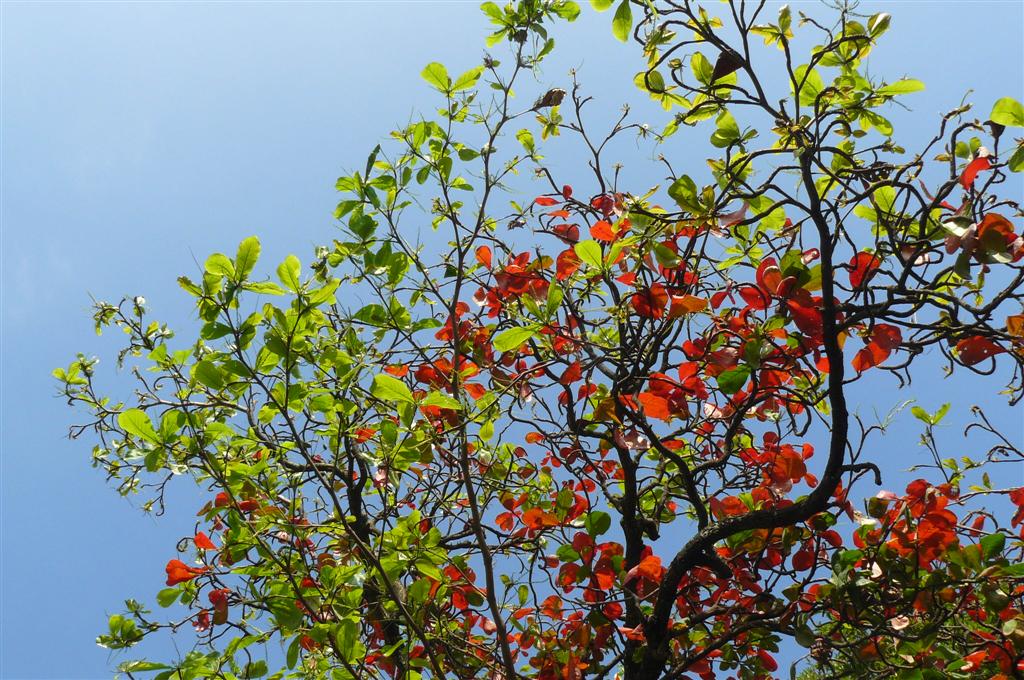
The red leaves before fall is always a joyful sight against a blue sky, esp. when they were lit by the sun.


I cut up a leaf for fun.


The tree bears fruits.  Sometimes, breaking the fibrous nuts is worth the effort.  Raw almond has its taste.    
 Its flowers and fresh geeen leaves also made an interesting subject for photography.


Many birds chose the high branches of this beautiful almond tree to rest in the shade of the huge leaves.  Now the high branches are gone.


It is a favourite tree for the tailorbirds to make their nests.


The Weaver Ants too were fond of these huge leaves to build nests folding up the leaf or joining a few leaves together.
 The tree top was clearly visible in this satellite image from 2010.  Red circled.
Now see it closer, from the topmost balcony of the house.  All those leaves would come down! They were the new growths from the new branches. See how lush the growth is.  I could break the branches with a hooked knife attached to the tip of a long bamboo pole. Even then the leaves were too much for me. 

I decided to further cut the branches of the tree to allow more light in the Yarden and also to have lesser leaves because there was no proper method of disposing them now. It was this size and one large side branch needed to be cut. 

My friend Ramu gave me a beautiful saw with a telescopic handle. The one in the above picture is now sawed down with that. I had sawed about 75% but suddenly got doubtful about where it would fall, though my estimate proved to be near correct.  I made an SOS to Ramu to come for help.  He arrived in ten minutes, in spite of being busy at that very time.  "Hey, is that all, why do you fear?"  It was no SOS to him!  He sawed the remaining portion for a couple of minutes.... THUD!  And went away on his errand. 
The branch fell on the arch making it crooked and ugly.  The arch was a gift from my friend Meera, another plant lover. Now my garden plan may change for the front yard because of this not unexpected damage.
The branch and the arch in one frame - fish eye lens - taken a few days earlier.  This is probably the last of the arch images in its original shape. 
"See the saw."  An Indian saw the German Saw. Here it is!


It helped me make firewood size pieces also, easily, without much effort.  When we have the right tools, things get a lot easier.


This is what remains now, but I expect it come back. And this time, I'll be ready with my tools to shape the way I want without the tree causing problems but I'll see that some tailorbirds would make nests by April next when it is their season. 

I had made my own leaf plate too once just for fun, by joining about 7 leaves and had my lunch on it.   
This post turned out to be a mountain out of a mole hill!  Thanks for reading.